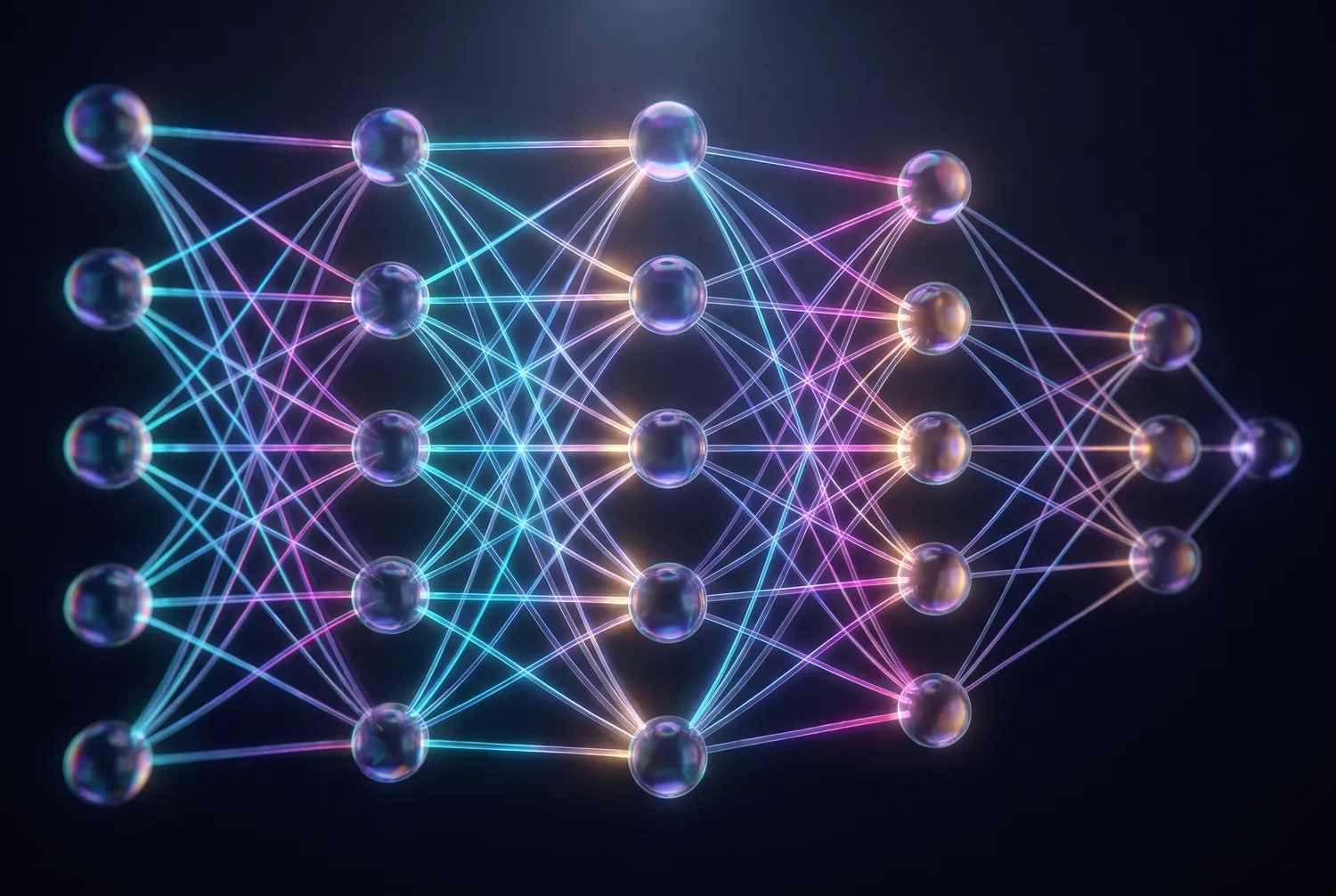
- A neuron weighs its inputs, adds them up, and fires if the total is strong enough.
- Wire neurons into layers and they turn raw input into a decision.
- "Deep" just means many layers; learning means nudging every weight toward the right answer.
01The dial that started it all
It takes a few numbers in, multiplies each by a weight, adds them up, and if the total is strong enough — it fires.
What the weights actually do
Everything in a neural network is built from this one part: the artificial neuron. The weights are the important bit — they decide how much each input matters. A big weight says "this is a big deal"; a tiny one says "barely listen." Learning is nothing more than finding good weights.
Picture a sound mixing desk. Each slider sets how loud one instrument is. A neuron is that desk: the weights are the sliders, deciding how loudly each input comes through in the final mix.
02Stack them into layers
Toggle the features and watch the signal light up the layers.

What you just saw
An input layer takes the data in, hidden layers pass signals along, and an output layer gives the answer — numbers flowing left to right, reshaped at each step.
You never told it "paws + barks = dog." You set the inputs; the weights, tuned in advance, did the deciding. Change the inputs and the same network reaches a different conclusion. That's a neural network thinking, in miniature.
03What "deep" really means
Why depth helps
Stack many hidden layers between input and output and you have a deep network. Each layer builds on the one before:
- Early layers spot basic features — an edge, a curve, a colour.
- Middle layers combine those into shapes — an eye, a wheel, a letter.
- Later layers assemble shapes into whole concepts — a face, a car, a word's meaning.
Depth lets a network learn in stages — simple parts first, then combinations. That's why deep networks can handle messy things like images, speech, and language.
04How a network actually learns
Measure the error, then turn every dial a hair toward the right answer. Do it across millions of examples, and a random network becomes a sharp one.
The intuition (no maths needed)
When the network gets an example wrong, it asks: which dials, nudged which way, would have made me less wrong? — then nudges every weight a tiny bit that way. That process is called backpropagation, but you don't need the maths. A network starts as random dials, and training is the patient work of tuning them.
This is the same machinery behind the AI you use. Chatbots — ChatGPT, Claude, Gemini and the rest — are deep neural networks at heart. Next we'll see the trick that turns one into a writer — that's Step 04.
- A neuron multiplies inputs by weights, sums them, and fires if the total is strong enough.
- Wired into layers, neurons turn raw inputs into a decision — as you saw in the live network.
- "Deep" just means many layers, which lets the network build from simple features up to whole concepts.
- Learning = nudging every weight toward the right answer, over and over (backpropagation).